
Kitchen Painting in Vancouver: Warm Colours and Finishes That Clean Well
A warmer kitchen still has to cope with cooking. A soft beige beside oak cabinets needs to look right and handle fingerprints, steam, and dinner splashes. Kitchen painting brings colour and cleanability into the same conversation.
Recent Metro Vancouver projects showcase warm wood, pale neutrals, and mixed painted and natural surfaces. Keep the materials you like, choose a compatible wall colour, and match the finish to daily use. The local examples below show how to apply that approach.
Our starting recommendation for kitchen walls is a high-quality washable satin. Compare it with an appropriate eggshell or washable matte if you want less reflection. Semi-gloss is useful for frequently handled woodwork and selected walls. Product formulation, preparation, and full curing matter alongside the sheen.
Luxe Layers can help you plan colours and finishes through our interior painting service, whether you are refreshing a kitchen or connecting it visually with the rest of your home.
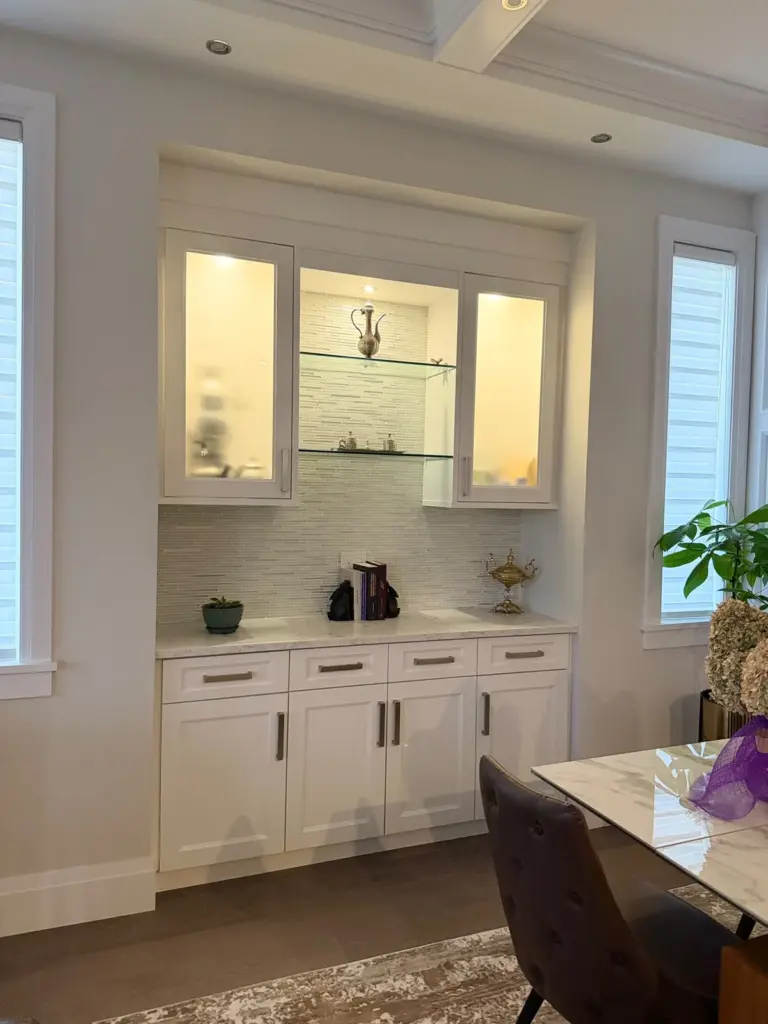
Painted cabinetry and neutral interior walls from the Luxe Layers project gallery.
Kitchen paint sheens at a glance
Flat or matte
Low shine. Ordinary flat finishes can mark or change sheen when rubbed; specialist washable matte products are exceptions.
Useful starting point: Lower-contact walls where appearance is the priority; check the product.
Eggshell
A softer look with some washability. Cleaning performance varies significantly by paint line.
Useful starting point: Open-plan kitchen and dining walls with moderate wear.
Satin
Usually a useful balance of wipeability and visible shine.
Useful starting point: Everyday kitchen walls.
Semi-gloss
Often well suited to repeated cleaning; reflects more light and reveals surface flaws.
Useful starting point: Frequently handled trim and doors; selected walls.
Gloss or high gloss
Durable options exist, with pronounced reflection and demanding preparation.
Useful starting point: Cabinetry, woodwork, or a deliberate glossy design.
Comparison is a selection guide, not a scrub-test ranking across brands. Sheen names and performance vary by manufacturer and product.
What is current in Vancouver kitchens
The clearest local direction is warmth with contrast: wood grain, gentle neutrals, and finishes that feel at home beside living and dining areas. These are examples from local projects and showrooms, rather than a poll of every Vancouver household. Here is how we would apply those ideas when planning kitchen painting.
Warm whites and sandy neutrals
Vancouver-based NUOVO Kitchens documents a 2026 project with sandy beige cabinetry, tonal stone, brass hardware, and warm task lighting. For clients who want that softer look without changing the whole kitchen, a warm off-white, cream, or pale putty wall colour is a useful sample direction. Compare it against the existing countertop and backsplash; their undertones will influence which neutral works.
Natural wood beside painted surfaces
HAVAN’s 2026 kitchen showcase features wood-grain lower cabinets paired with white uppers, along with rift-cut oak millwork. If your existing wood is in good condition and you like its grain, consider keeping it and repainting the surrounding walls. A current-looking kitchen does not require painting every cabinet. We can discuss the larger palette through our residential painting services.
Soft-looking finishes with real cleaning performance
Bauformat BC’s North Vancouver showroom pairs warm oak with matte lacquer and displays anti-fingerprint finishes. That is a useful aesthetic reference, but factory-made cabinet finishes are not interchangeable with wall paint. For a similarly quiet wall appearance, compare washable matte or eggshell products with satin in the actual kitchen light. Check cleanability for the exact coating.
Colour and lighting chosen together
Marina Medina’s Lynn Valley project combines white oak, painted hardwood, a warm neutral wall colour, and layered lighting. This is a North Vancouver example, not a Luxe Layers project. Its useful lesson for your repaint is to sample beside the materials staying in place, with both daylight and your cooking lights switched on. A small paint chip cannot show the complete effect.
Our palette suggestions are practical interpretations of these local examples. Test them against your own materials, lighting, and cleaning needs.
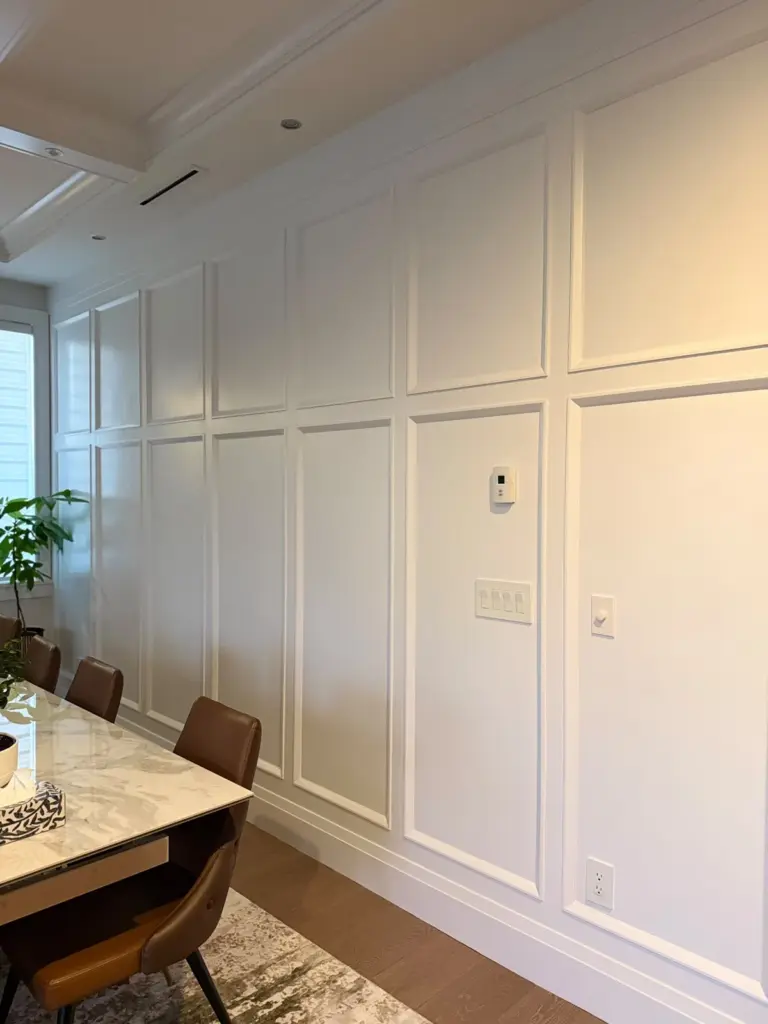
Luxe Layers project gallery: painted panelling beside a dining area.
Choose a kitchen finish for how you live
Two tins labelled satin can behave differently. Binder formulation, stain resistance, film build, preparation, and curing all affect how a coating performs. A well-formulated washable matte may suit a kitchen better than a less durable paint with more shine. Sherwin-Williams specifically notes that modern flat finishes can offer good washability, while satin and semi-gloss generally provide greater scrubbability.
Washable is not the same as scrub-proof
Washability describes removing dirt from the finish. Scrub resistance concerns how well the film withstands repeated rubbing. Stain resistance concerns whether contamination leaves a lasting mark. Look for the capabilities you need in the exact product, rather than treating one word on the tin as a promise that anything will wipe off.
Matte can work when the product is right
A low-sheen finish is useful when you want quiet walls or want to reduce the visibility of minor flaws. Ordinary flat paint is less forgiving of greasy fingerprints and repeated spot cleaning. A purpose-made washable matte is a separate option: Benjamin Moore, for example, lists burnish and scuff resistance for its Aura Interior Matte. Check the current local product information before choosing.
Eggshell suits some open-plan kitchens
If the kitchen shares uninterrupted walls with the dining or living area, eggshell can help retain a softer appearance. It is most convincing where the painted wall is not taking the worst of the cooking splatter. Compare a sample in the actual light and check the selected paint line’s cleaning guidance.
Satin is a balanced place to start
For a family kitchen, satin is often a sensible first sample: enough sheen for a practical finish without making every wall look polished. That does not make every satin product suitable for every kitchen. Evaluate the formulation alongside how often you cook and clean.
Semi-gloss and gloss need smoother preparation
Higher sheen catches light on dents, filler edges, old drips, and roller texture. It may be the right choice for frequently cleaned woodwork, but applying it to a large wall can make existing imperfections harder to ignore. Gloss should be chosen for its appearance as well as its maintenance characteristics.
If you are updating more than the kitchen, our residential painting services can help you consider how colours and finishes relate across adjoining rooms.
Plan each surface in your Vancouver kitchen
Walls
Start with a washable satin, then compare it with a suitable eggshell or matte if you prefer less reflection. Under-cabinet lighting and daylight from a side window can reveal texture that is barely visible on a sample card. Sample the actual product and sheen on a representative area before committing.
Doors, frames, and baseboards
These areas get touched, bumped, and wiped. Satin or semi-gloss in a coating intended for trim is a useful starting point. The trim product can differ from the wall paint even when you use the same colour. Our interior painters can include these details in the scope rather than treating the kitchen as walls alone.
Cabinet doors and drawer fronts
Select a coating intended for cabinetry and follow its preparation and curing instructions. The word semi-gloss does not turn ordinary wall paint into cabinet paint. A cabinet finish must cope with handling and doors meeting frames. Manufacturer-designated cabinet products, such as Benjamin Moore Advance, illustrate why intended use matters. Satin and semi-gloss are options within that kind of system.
If cabinets are part of your plans, ask Luxe Layers to assess the surfaces and confirm the proposed scope. A wall repaint and cabinet refinishing are different jobs.
Ceilings
A flat finish reduces reflection, but an ordinary ceiling paint may not be the best choice where steam or cleaning is a recurring issue. Consider the actual exposure and product suitability. Benjamin Moore lists its Kitchen & Bath Satin for kitchen and ceiling applications, showing that a kitchen ceiling does not have to follow the usual flat-ceiling approach.
Splash zones
More sheen does not make ordinary wall paint a substitute for a suitable backsplash. Where a wall faces persistent splashing, concentrated grease, or heat, review the surface protection and appliance requirements. Changing the sheen alone does not address the exposure.
Picture a working evening in your kitchen
Before choosing finishes, walk through one normal cooking session. Where do you lean a hand while opening a drawer? Which wall catches droplets when you rinse dishes? Where does the kettle send steam? Which surfaces never need more than dusting? Use those observations to divide the room into light-contact and frequent-cleaning areas. The finish should reflect that pattern, not just the room’s name.
Preparation makes kitchen painting last
A washable finish still needs something clean and stable to adhere to. In a kitchen, grease removal deserves attention before repairs and new coats. Benjamin Moore recommends washing greasy kitchen walls with a grease-cutting detergent solution, followed by clean water to remove cleaning residue. Allow the surface to dry before continuing.
Clean before assessing adhesion
A wall may look tidy while retaining residue around the stove, handles, or top edges of cabinets. Use a cleaner suitable for the surface and follow its instructions. Painting over contamination can undermine the result regardless of sheen.
Repair, dull, and prime where needed
Identify loose coatings, cracks, and damaged areas. Existing glossy finishes may require cleaning and dulling before recoating; bare patches or difficult surfaces may need an appropriate primer. Primer selection depends on the substrate, existing coating, and the new system. It is not automatically the same on a repaired wall and a cabinet door.
Resolve recurring moisture problems
If paint repeatedly peels near a leak or persistent dampness, address the source before repainting. A moisture-resistant coating does not repair plumbing or replace effective ventilation.
Kitchen preparation can be included in your interior painting estimate. Describe greasy areas, peeling, stains, and past repairs so the scope reflects what is actually needed.
How to clean painted kitchen surfaces
Start gently and test out of sight. On a cured finish, remove loose dust, then use a soft cloth or sponge with a mild cleaning solution allowed by the manufacturer. Work with light pressure, remove soap residue with a clean damp cloth, and blot dry. Avoid soaking seams or leaving moisture sitting on cabinet edges.
Do not keep scrubbing a mark that is not lifting. Abrasive pads and repeated rubbing can wear the coating or create a polished patch known as burnishing. A surface can be clean yet look permanently different because its sheen has changed.
Dry to the touch is not ready for washing
Paint continues to harden after it feels dry. Benjamin Moore’s general care guide advises allowing about 30 days before cleaning newly painted walls and cabinets. That is guidance, not a universal timetable: use the selected product’s current instructions and allow for site conditions. Ask your painter when gentle use, washing, and normal handling are appropriate.
Kitchen painting questions
Is satin or semi-gloss better for kitchen walls?
Satin is our suggested starting point when you want practical cleaning with restrained shine. Semi-gloss is worth comparing for frequent wiping or a deliberately brighter finish. The final choice should account for the exact paint, wall condition, and lighting, not sheen alone.
Can I use matte paint in a kitchen?
Yes, if the product is suitable for the exposure and has the cleaning performance you need. Check a washable matte rather than assuming standard flat paint will tolerate the same treatment. The lower shine can suit an open-plan kitchen, but repeated greasy splashes demand more scrutiny.
Should kitchen walls and cabinets have the same finish?
They can have the same sheen, but they do not need the same product. For example, satin walls and satin cabinet enamel can look coordinated while using different coating systems. Confirm the cabinet material and manufacturer recommendations.
Why does my wall turn shiny after cleaning?
Rubbing can change the surface and increase its sheen. This is called burnishing or marring. It is particularly noticeable when a spot is scrubbed harder than the surrounding wall. Stop abrasive cleaning and assess whether the area needs recoating.
Can I put satin over existing semi-gloss?
Often, but the existing coating needs to be sound and suitably prepared. Cleaning, dulling, repairs, and sometimes a bonding primer may be required. Follow the new coating system’s instructions rather than relying on the word self-priming.
Our kitchen painting recommendations for clients
Luxe Layers brings 20 years in the painting business and more than 700 completed jobs to its painting services. For clients who want a warmer kitchen that is easier to maintain, we recommend starting with the surfaces and materials that will stay: cabinets, flooring, countertops, and backsplash.
Build a small palette around those fixed materials. Test a warm neutral on the walls, compare satin with a suitable lower-sheen product, and choose a separate trim or cabinet system where needed. You can keep wood grain, add a painted contrast, or simply refresh the walls; the scope should suit your kitchen and budget. Our interior painting service includes colour consultation to discuss lighting, finishes, and adjoining rooms.
Whether you need a kitchen refresh or a wider home painting project, request a free estimate with Luxe Layers. Share photos, the surfaces you want painted, and what bothers you about the current finish so we can discuss a suitable plan.
Planning a kitchen refresh?
Share your photos, the surfaces you want painted, and your preferred timing.